




Careers and Transitions
It is our aim for every pupil to complete Year 11, and leave Endeavour Academy prepared for life in the real world with the ability to manage challenges and their own emotions. The Careers programme is created to enhance pupils’ prospects, encouraging them to build positive relationships within our community and create opportunities for them to gain the knowledge and skills for future learning and employment.
At Endeavour Academy we are committed to providing all pupils with a planned programme, information, advice and guidance preparing them for the challenges and opportunities of further education, training and working life, therefore reducing the risk of becoming NEET (Not in Education, Employment or Training).
Each curriculum area within this school promotes links with the world of work through their; curriculum delivery plans, trips and displays.
The tutor programme also has a dedicated week to careers each full term where pupils can learn about the different paths they can take post 16 to ensure they have a broad and balanced career understanding of the routes that are available to them.
Endeavour Academy Careers Lead:
Emma Seffens
Email: emma.seffens@endeavour.lseat.org.uk | Tel: 01322 553 787
Pupil Zone
It’s never too soon to start thinking about what you want to do after you leave school.
Things like where you live, what grades you’re likely to get and what you’re interested in can help you make informed choices about your future. Often, the choice is between sixth form, college, an apprenticeship or specialist training provider.
So far, your education has probably been set out for you – from primary to secondary school. You have most-likely not had to think about ‘what next’ – but now you’re expected to know what you want to do?
First – don’t panic! You may feel that this is the most important decision of your life, but it isn’t a final choice for example; if you choose to go to college but find an opportunity within an apprenticeship it is ok to change your mind.
Doing some research into your options is always going to help with making the right choice for you. Try to ignore what your friends are doing (at least just for a moment) and focus on what you want to achieve for yourself. The careers and transition team will help you explore your options and interests and submit applications.
Colleges
Colleges are separate from schools, so everyone turns up on their first day as a new student. Colleges tend to offer A levels, NVQs, Diplomas and Foundation Learning. Sometimes colleges specialise; for example, you might have an agricultural college that does farming and animal care related courses, or a catering college that specialises in cookery courses.
Traineeships
Traineeships are designed to help young people who want to get an apprenticeship or job but don’t yet have appropriate skills or experience.
Traineeships are an ideal opportunity for young people, aged 16 to 24, who are motivated to get a job but lack the skills and experience that employers are looking for.
Those who have been unsuccessful when applying for an apprenticeship or other job due to a lack of skills and experience are most likely to be good candidates for a traineeship.
Apprenticeships
With an apprenticeship, you would be working for an employer, earning a wage (in 2025, the minimum wage for a 16-year-old apprentice is £7.55 an hour) and studying for a qualification (often an NVQ) at the same time. You would be linked with a college or training provider to make sure you get all of your work done for your qualification.
An apprenticeship offers an alternative path into employment. Sure, it hasn’t got the academic edge of going to university, but an apprenticeship should leave you more prepared for the workplace – which is the final destination anyway! An apprenticeship will teach you a skill or trade, while offering on-the-job experience and a pay-packet. There are a surprisingly wide range of apprenticeships available to search now in a variety of job sectors.
Sixth forms
Sixth forms are often attached to a school. There are advantages and disadvantages to this. If it’s the school you’ve already been at for a few years, you’ll feel comfortable and know your way around. Some people can find attending a completely new school a bit scary because lots of people there will already know each other. At sixth form you will work towards achieving A-Levels which are usually needed to attend university.
What grades do you need?
The table below shows the different qualification levels. Often, to get onto a course at a particular level, you will need to have already achieved the level below the one you’re applying for. For example, to get onto a Level 2 National Diploma you will often be asked to have some GCSEs at grades 4-1. The higher the GCSE grades, the higher the level of course you can start on.
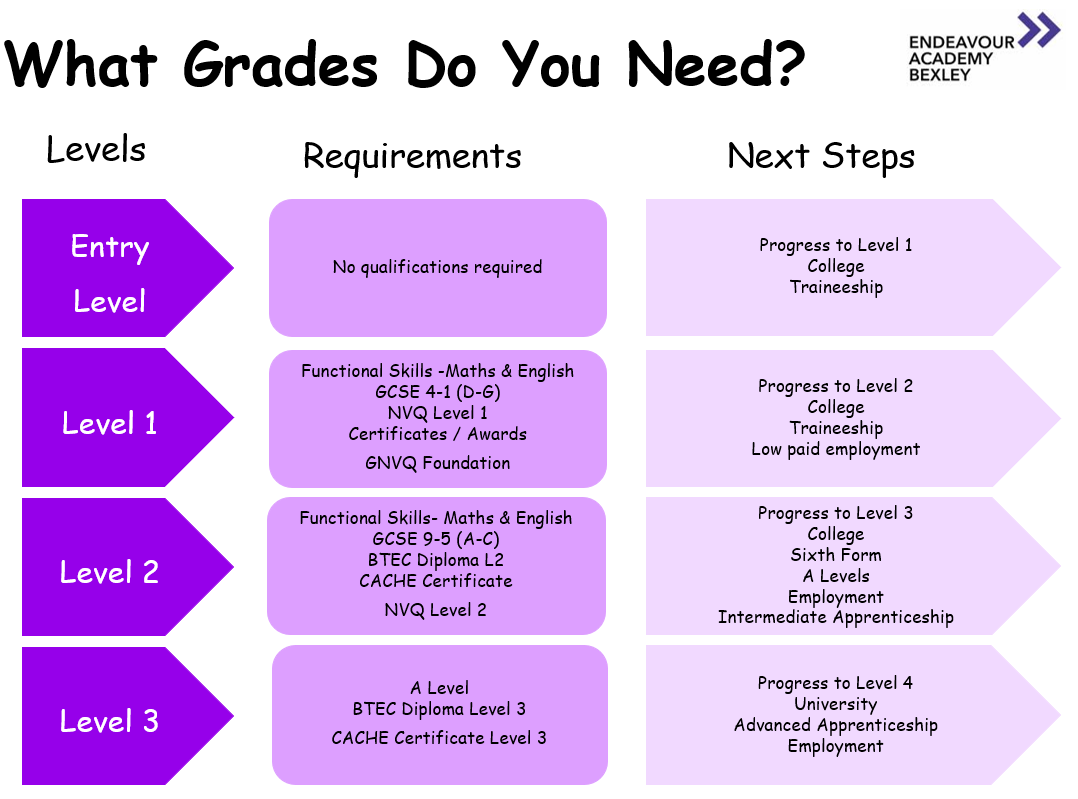
There are some courses where you will need to start on Level 1 or Level 2, even if you get good GCSE results. This is often for practical courses, like hairdressing, construction, catering and animal care.
College
- London South East Colleges https://www.lsec.ac.uk/
- Shooters Hill Sixth Form College https://www.shc.ac.uk/
- North Kent College https://www.northkent.ac.uk/
- Traineeship -https://www.gov.uk/find-traineeship
- Apprenticeships - https://www.apprenticeships.gov.uk/
- Amazing Apprenticeships – https://amazingapprenticeships.com/about-ask/
- Sixth Forms - https://www.youthemployment.org.uk/advice-for-starting-sixth-form-tips-for-success/
- Online Career Coach - https://lsec.lightcastcc.com/browse-careers?region=LSEC%20College%20area%20&radius=
- Independent career guidance - https://nationalcareers.service.gov.uk/
Financial Support - As a 16 to 19 year old student you may be able to get help with money.
There are two types of 16 to 19 bursary:
Vulnerable student bursary
Depending on your circumstances you could get a bursary of up to £1,200 to help with living costs, such as books, specialist clothing, transport, and food.
This group includes:
- People in care
- Care leavers
- People claiming income support
- Disabled young people who receive Employment Support Allowance and Disability Living Allowance
Discretionary bursary
You could get a discretionary bursary if you need financial help but don’t qualify for a vulnerable student bursary. Your education or training provider decides how much you get and what it’s used for.
How is your bursary paid?
Your education or training provider will decide how you get your bursary. You might be:
- Paid in full or in instalments
- Paid in cash, by cheque or through a bank account
- Given things like a travel pass, free meals or books instead of money
- Some providers also offer one off payments to cover study trips or travel for university interviews.
Your provider will set conditions that students should meet to receive a bursary, for example, linked to behaviour or attendance and your bursary can be stopped if you break the rules. For more information please visit https://www.gov.uk/1619-bursary-fund/what-youll-get
Post 16
Due to the changes in Government legislation to raise the participation age to 18 years, the Careers and Transition team also support and track our school leavers through guidance, support and the monitoring of placement progress.
We also work in liaison with support services and agencies such the Youth Offending Team, CSC, Porchlight, St Giles and more, in relation to those most at risk of or who have become NEET. All work with post-statutory students adheres to the expectations outlined in the Academies Safeguarding Policy and as such all safeguarding concerns are responded to accordingly.
Students are tracked and supported for two years once they have completed their education. During their third year support is only available upon students request.
|
Post Statutory - Year 1 (School - Year 12) Support Service |
Post Statutory - Year 2 (School - Year 13) Support Service |
Post Statutory - Year 3 (School - Year 14) Support Service |
|||
| Young people that are EET (in Education, employment or training) | Young people that are NEET (not in Education, employment or training) | Young people that are EET (in Education, employment or training) | Young people that are NEET (not in Education, employment or training) | Young people that are EET (in Education, employment or training) | Young people that are NEET (not in Education, employment or training) |
|
Termly calls / emails to confirm destination and progress.
Professional 1:1 support advice and guidance meetings available upon request.
Communication with professionals when required |
Termly calls / emails to confirm destination and progress.
Professional 1:1 support advice and guidance meetings available upon request
Communication with professionals when required
Contact to support student needs
Support with signposting and referrals to suitable education or training providers |
Calls / emails to confirm destination and progression Terms 1, 3 and 5.
Professional 1:1 support advice and guidance meetings available upon request
Communication with professionals when required |
Termly calls / emails to confirm destination and progress.
Professional 1:1 support advice and guidance meetings offered
Communication with professionals when required
Contact to support student needs
Support with signposting and referrals to suitable education or training providers |
Calls / emails to confirm destination and progress between Terms 1 and 2 (Sept - Dec).
Professional 1:1 support advice and guidance meetings available upon request. |
Calls / emails to confirm destination and progress between Terms 1 and 2 (Sept - Dec).
Professional 1:1 support advice and guidance meetings available upon request. |
Parents and Carers
Parent/Carer checklist:
- Encourage your child to research their options
- Check the dates of Post-16 & college open events and put them in your diary
- Encourage your child to discuss their options with their school’s careers and transition team, or contact the National Careers Service
- Ensure application forms are completed and submitted on time, sixth form and college applications typically open in October
- If your child is interested in an apprenticeship or traineeship get them to register with the National Apprenticeship Service – a number of larger companies advertise their apprenticeship opportunities for school leavers between November and February
- Sign-up for the London Borough of Bexley’s Jobs & Opportunities for Young People Newsletter to receive information and inspiration on post-16 opportunities, and encourage your son or daughter to do the same
- If you are worried about finances contact sixth forms, colleges and training providers and ask about the 16 to 19 Bursary Fund
- Support your child to develop a back-up plan, just in case
Useful links –
- Talking Futures - https://www.talkingfutures.org.uk/
Careers Programme
|
Year 11 |
|||
|
Learning Intent |
Activity |
Gatsby Benchmark |
|
|
Autumn Term Sept-Feb |
To discuss career interests and aspirations with a professional independent advisor in line with LMI and create a career action plan that supports EHCP. To gain information and knowledge of local and national; further education, higher education and employer opportunities. To have an insight on what local colleges offer and the entry requirements The opportunity to develop communication skills needed in interviews. |
1:1 Career Guidance Session National apprenticeship & education event Virtual Career Fair Further & Higher education visits / open days/online presentations Talk the Talk Skills and strengths oracy workshop (Jack Petchey) |
2,3,5,7,8 |
|
Spring Term Feb-April |
To have knowledge around a variety of career paths and understanding of routes to meet goals including Apprenticeships and T Levels. To link Science, Technology, Engineering and Maths to careers and challenging stereotypes. To identify interview techniques and how to implement them. Personal Development, Careers exploration and Aspiration raising. |
Provider / Employer Assembly (x2) National Apprenticeship Week External STEM demonstration activity/ STEM themed carousel day (Big Bang Event) Mock Interviews/ External Visitors (Talentix visit) Careers themed week College Open days & Tours First aid training |
2,3,4,5,7 |
|
Summer Term April- July |
To be informed of what an employer expects to see on a CV To improve confidence around transitioning to new provision. |
CV Workshop College transition tours / taster days. Final 1:1 with Careers advisor |
3,8 |
|
Year 10 |
|||
|
Autumn Term Sept-Feb |
To identify strengths, weaknesses, opportunities and threats. To gain information and knowledge of local and national; further education, higher education and employer opportunities. |
1:1 with Careers advisor KS4 Residential The King’s Trust National apprenticeship & education event |
3,5,7,8 |
|
Spring Term Feb-April |
To have knowledge around a variety of career paths and understanding of routes to meet goals including Apprenticeships and T Levels. Linking Science, Technology, Engineering and Maths to careers and challenging stereotypes. To identify interview techniques and how to implement them. Personal Development, Careers exploration and Aspiration raising. |
Provider / Employer Assembly (x2) National Apprenticeship Week External STEM demonstration activity/ STEM themed carousel day (Big Bang Event) Mock Interviews / External Visitors (Talentix) Careers themed week First aid training Tate Modern Museum Science Museum |
2,4,5,7 |
|
Summer Term April- July |
To have an understanding of how to open a bank account, manage money and credit. To gain first-hand experience in a workplace environment To discuss career interests with a professional independent advisor in line with LMI and create a personalised career action plan |
HSBC Smart Banking Modules during PSHE lessons Work Experience/ work shadowing (1:1 support will be given to those pupils that need it) 1:1 Career Guidance Session – Action planning |
2,3,6,8 |
|
Year 9 |
|||
|
Autumn Term Sept-Feb |
To be aware of and relate to previous student experiences and successes following education at Endeavour. Identify personal skills and strengths To have an understanding of complex financial topics that will prepare for life in modern Britain. |
Alumni “My Story” Personal development career focus Army Careers workshop HSBC Smart Money Programme “Fraud & Your Money” |
3,5,8 |
|
Spring Term Feb-April |
Personal development, Careers exploration and aspiration raising. Knowledge of Apprenticeships / T Levels Linking interests to future career paths |
Careers themed week Provider Visit / talk (x2) National Apprenticeship Week Animal Encounters Music workshop Gaming Development workshop Army Introduction within Personal Development lessons |
2,3,5,7 |
|
Summer Term April- July |
Careers exploration, aspiration raising and personal development. Linking Science, Technology, Engineering and Maths to careers and challenging stereotypes Experiences of workplaces To have an understanding of complex financial topics that will prepare for life in modern Britain. |
1:1 CIAG Support with choosing options “Owning your future” External STEM demonstration activity/ STEM themed carousel day (Big Bang Event) Tutor group assembly- Q&A all things work experience ahead of going out on work experience next year. HSBC Smart Money Programme “Borrowing money & managing debt” |
2,4,8 |
|
Year 8 |
|||
|
Autumn Term Sept-Feb |
To be aware of and relate to previous student experiences and successes following education at Endeavour. To have an understanding of complex financial topics that will prepare for life in modern Britain. |
Alumni “My Story” HSBC Smart Money Programme “Savvy Shopping” |
3,8 |
|
Spring Term Feb-April |
Careers exploration, aspiration raising and personal development. Knowledge of Apprenticeships / T Levels |
Careers themed week 6 Week Career programme during Personal Development lessons Animal Encounters Provider Visit / talk (x2) National Apprenticeship Week |
3,5,7,8 |
|
Summer Term April- July |
Linking Science, Technology, Engineering and Maths to careers and challenging stereotypes To have an understanding of complex financial topics that will prepare for life in modern Britain. |
External STEM demonstration activity/ STEM themed carousel day (Big Bang Event) HSBC Smart Money Programme “Household budgeting” |
4,8 |
|
Year 7 |
|||
|
Autumn Term Sept-Feb |
Developing the skills required to successfully work within a team. Self awareness- what skills are required?
Encounters with employees To have an understanding of complex financial topics that will prepare for life in modern Britain. |
Team Building workshop History trip- Colchester Castle HSBC Smart Money Programme “Banking 101” |
3, 5, 6, 8 |
|
Spring Term Feb-April |
Careers exploration, aspiration raising and personal development. |
Careers themed week 6 Week Career programme during Personal Development lessons Animal Encounters |
5,6,7 |
|
Summer Term April- July |
Linking Science, Technology, Engineering and Maths to careers and challenging stereotypes To have an understanding of complex financial topics that will prepare for life in modern Britain. |
External STEM demonstration activity/ STEM themed carousel day (Big Bang Event) HSBC Smart Money Programme “Smart Gaming” |
4,8 |
Careers Policy
Please click here to view our Careers & Transition policy.
Labour Market Information
What is Labour Market Information (LMI)?
LMI effectively describes the world of work – it ranges from descriptions of different careers, their entry routes, promotional prospects, salaries paid, skills and qualifications needed, etc.
Crucially for young people, LMI also covers future demand – what kinds of jobs will be in demand after leaving school and what kinds of skills will be needed.
Why is LMI Important to Our Students?
‘It is vital, in an environment where new industries are emerging and many of the most important jobs of the future don’t yet exist, that individuals have access to high-quality labour market information and earnings data to underpin their choices’. Anne Milton MP
Below is a wealth of information to support LMI.
Learning from Careers and Labour Market Information.
Understanding LMI is becoming more and more important as the world changes, so that all students can be aware of where different job roles that are needed around the country and what types of jobs may need more people in the future. Below is information on what LMI actually means.
|
What do people actually do in this job or industry? |
How much do people get paid in this job or industry? |
What qualifications do I need to do this job? |
What skills or qualities do I need to do this job?
|
What are the typical working hours for this job? |
|
How many people work in this job or industry? |
What percentage of men and women work in this job or industry? |
Where can this job or industry take me in the future? |
Where are these jobs located around the country? |
How many of these jobs will there be in the future? |
Skillsometer
Skillsometer has been designed for those who are not sure what jobs they may be interested in. Thinking about skills, interests and the ways these can link to jobs can be a helpful first step in identifying possible future jobs.
The quiz requires you to reflect on a number statements and decide what you love, are not sure about or dislike. The statements are presented within six well established occupational categories (Artistic, Realistic, Investigative, Conventional, Enterprising, and Social), which are then ranked against jobs. Once you have completed the quiz you are given a short list of job suggestions that are most likely to be suited to your own particular skills and interests. Each job can be explored as a description is presented together with information on pay and hours. For further information on the job, and to compare with other jobs, you could then go to the Careerometer below.
https://www.lmiforall.org.uk/skillsometer/
LMI - Job vacancies
For up-to-date information on pay, employment levels and geographic distribution for different jobs please visit National Careers Website.
https://www.cxk.org/
Jobs for the future
With the ever changing world of technology who can predict the careers which will be in demand in the future. https://www.jff.org/